
Understanding GST on Wedding Vendors: What You Need to Pay
ArticlesPlanning your wedding budget wisely means understanding the taxes involved. This guide explains GST applicable to wedding vendors, helping couples and planners know what they may need to pay, anticipate additional costs, and make informed decisions while booking essential wedding services.
Planning a wedding involves more than choosing the right venue, décor, outfits, and vendors. Taxes can also influence the final cost of each service. Goods and Services Tax, commonly known as GST, is charged on several wedding related services in India and may appear separately on quotations or invoices.
Understanding GST before booking wedding vendors helps couples create a more accurate budget, compare quotations fairly, and avoid unexpected additions to the final bill. The exact amount depends on the type of service, the vendor’s registration status, the applicable tax rate, and the way the service is packaged.
What Is GST and Why Does It Matter for Weddings?
GST is an indirect tax charged on the supply of goods and services in India. In a wedding budget, it may apply to services such as banquet hall bookings, catering, decoration, photography, makeup, entertainment, transportation, accommodation, and event planning.
The tax is generally collected by a registered vendor from the customer and deposited with the government. This means the price initially discussed with a vendor may not always be the final amount payable. A quotation may show the service fee first and add GST separately at the end.
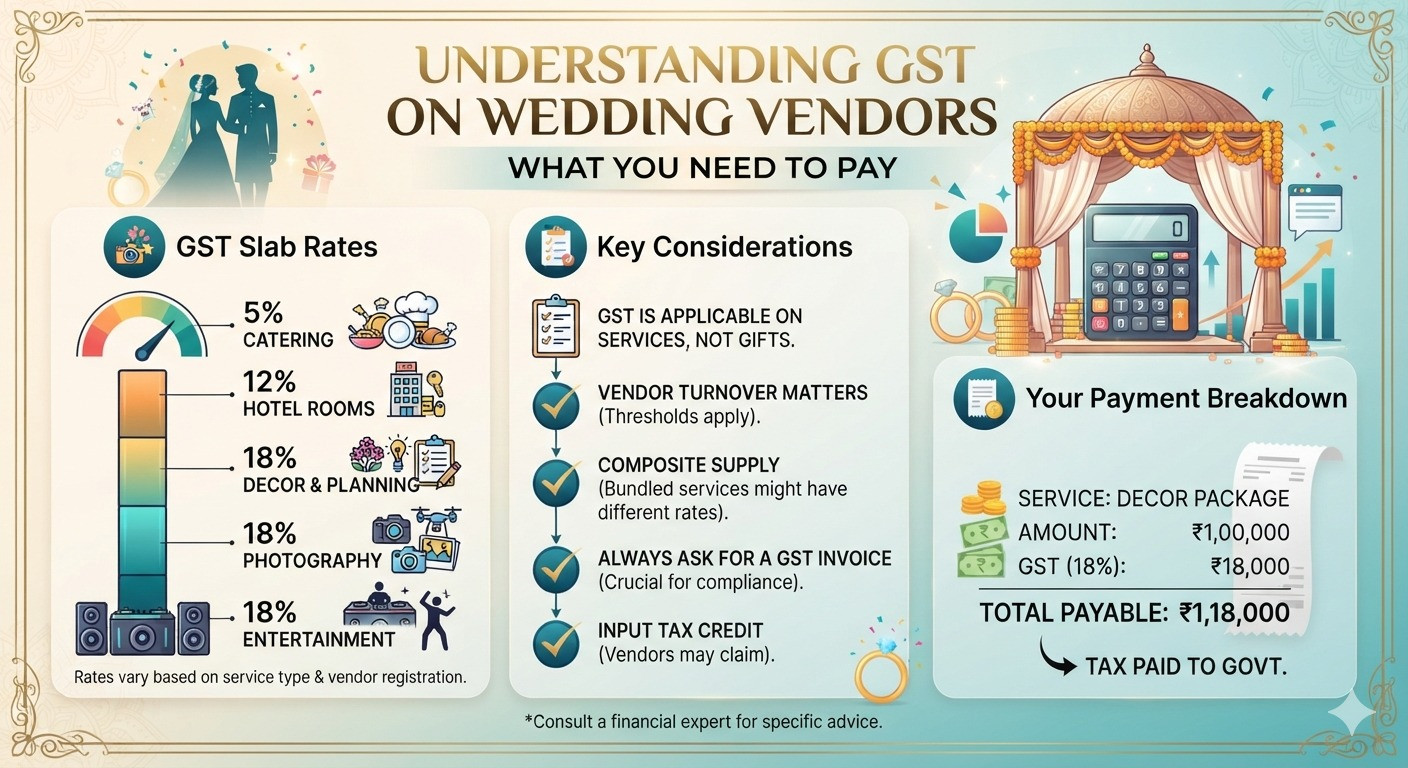
For example, if a wedding photographer quotes a professional fee of Rs. 1,00,000 and GST is applicable at 18 percent, the tax would be Rs. 18,000. The final amount would become Rs. 1,18,000. Asking whether a quote is inclusive or exclusive of GST is therefore an important part of wedding planning.
When Is GST Applicable to a Wedding Vendor?
GST is generally applicable when a vendor is registered under the GST system and provides a taxable service. Many organised wedding vendors, hotels, banquet venues, event planners, and professional studios are registered and issue tax invoices.
Small vendors may not always be registered, especially if their turnover is below the applicable registration threshold or if their business falls under a specific exemption. An unregistered vendor generally cannot charge GST separately on the invoice. However, couples should not assume that a lower quotation is always better. The service quality, written terms, payment records, and clarity about the final amount remain equally important.
A registered vendor should usually provide a GST invoice containing details such as the vendor’s legal name, address, GSTIN, invoice number, taxable value, applicable GST rate, and tax amount. Couples should retain these documents, particularly when the wedding is being managed by a planner, a business, or a family office that requires proper accounting records.
GST on Wedding Venues and Banquet Halls
Wedding venues can have different GST treatments depending on the nature of the property and the services included in the booking. A banquet hall, convention space, resort, hotel, or standalone event venue may charge GST on the venue rental, food, accommodation, décor, and other services as separate components.
Venue rental and event management services are commonly taxed at 18 percent when supplied by a registered business. However, the final treatment can vary when the venue provides a bundled package that includes catering, accommodation, décor, or other facilities.
Hotels may charge GST on rooms according to the applicable room tariff category. Hotel accommodation is generally taxed at 12 percent for rooms with a value above Rs. 1,000 and up to Rs. 7,500 per room per night, and at 18 percent when the room value is above Rs. 7,500 per room per night. Tax rules and rate classifications may change, so the hotel’s current invoice and official tax position should be checked at the time of booking.
A venue quotation should clearly state whether the price includes hall rental, furniture, electricity, service charges, catering, cleaning, security, and GST. If these items are shown separately, couples can understand the actual cost of each part of the wedding venue package.
GST on Wedding Catering
Catering is one of the largest wedding expenses, and its tax treatment can depend on the type of service and the location where it is provided. Catering supplied by a restaurant or food service provider may commonly attract GST at 5 percent without input tax credit, although the applicable rate can differ based on the specific arrangement.
A caterer providing food at a wedding venue, a hotel offering a wedding menu, and a restaurant included in a venue package may not always be treated in exactly the same way. The rate may also depend on whether the food is part of a larger composite package.
Couples should ask the caterer to separate the food value, service charges, equipment rental, staff charges, and other components in the quotation. If the vendor is registered, the invoice should show the correct GST classification and rate. It is also useful to confirm whether the menu tasting, welcome drinks, snacks, and late night meals are included in the taxable package or billed separately.
GST on Wedding Decorators and Event Planners
Wedding decorators and event planners often provide several services together. These may include concept planning, floral arrangements, stage design, lighting, furniture, seating, installation, logistics, and on site supervision.
Event management and decoration services supplied by registered businesses are commonly charged at 18 percent GST. However, if a planner purchases décor materials or hires other vendors, the final invoice may include different service components. The tax treatment should be reflected clearly rather than being added as an unexplained percentage to the entire bill.
Before signing a contract, ask whether the quoted amount includes GST, transportation, installation, dismantling, overtime, and changes requested after approval. A detailed proposal can prevent confusion when décor is modified close to the wedding date.
GST on Photography and Videography
Professional wedding photography and videography services are generally treated as taxable services. Registered photographers and studios commonly charge GST at 18 percent.
The taxable amount may include the photography team’s professional fee, cinematography, drone coverage where legally permitted, editing, albums, reels, additional hours, travel, and extra copies. Since many photographers offer packages, the contract should explain whether GST applies to the complete package or to separately listed services.
Couples should also confirm the number of events covered, delivery timelines, album specifications, and charges for additional hours. These details are not tax matters alone, but they help ensure that the taxable value on the invoice corresponds with the service actually agreed upon.
GST on Bridal Makeup, Grooming, and Mehendi
Bridal makeup artists, hairstylists, salons, grooming professionals, and registered beauty service providers generally charge GST at 18 percent. The same rate may apply to services for the bride, groom, family members, and wedding guests when supplied by a registered business.
The quotation should indicate whether trials, hairstyling, draping, travel, touch ups, and services at multiple venues are included. Mehendi services may also attract GST when supplied by a registered professional or business, depending on the vendor’s registration and service classification.
Since independent artists may operate differently from established salons or companies, it is important to ask for a clear written invoice and confirm whether GST is included in the quoted amount.
GST on Wedding Transportation and Entertainment
Transportation arranged for the wedding may include cars, buses, luxury vehicles, airport transfers, and guest shuttles. The applicable GST rate can vary depending on the type of vehicle, the nature of the hire service, and the terms of the arrangement. A registered transport operator should mention the applicable rate on the invoice.
Entertainment services such as DJs, live performers, sound providers, and professional anchors may also attract GST when supplied by registered vendors. Equipment hire and performance fees may be shown as separate items. Couples should check whether setup, technical staff, travel, and additional hours are included.
How GST Affects Wedding Packages
Many venues and planners offer complete wedding packages. These may combine accommodation, food, décor, venue use, furniture, lighting, and event coordination. While packages are convenient, they can make it difficult to understand how GST has been calculated.
Ask for a component wise quotation before making a payment. The document should show the base price, each major service, applicable GST, and the final payable amount. If one package includes services with different tax treatments, the vendor should clarify how each component is being charged.
A package that appears less expensive may not include taxes or essential services. Comparing the final amount, rather than only the base price, gives a more realistic picture of the wedding budget.
Important Questions to Ask Vendors
Before booking any wedding vendor, ask whether the quoted amount is inclusive of GST. Confirm the vendor’s GST registration status and request a proper tax invoice if GST is being charged. Ask for the exact rate and the services on which it applies.
It is also useful to clarify whether GST will be added to advance payments, additional services, last minute changes, overtime, cancellation charges, and transportation. The contract should state how changes in government tax rates will be handled between the booking date and the wedding date.
Do not accept an unexplained tax amount or a handwritten addition without supporting details. If there is uncertainty about the classification of a service, the vendor should verify it with a qualified tax professional.
Planning the Budget with GST in Mind
The easiest way to account for GST is to maintain two figures for every major booking: the base service cost and the expected tax. Add the tax amount before comparing vendors or finalising the total wedding budget.
Keep a separate record for venue, catering, décor, photography, beauty services, entertainment, transportation, accommodation, and planning fees. This makes it easier to identify which quotations are tax inclusive and which ones require an additional payment.
Tax rates and GST rules can change, and the treatment of a service may depend on the vendor’s business structure and invoice details. Couples and planners should therefore verify the current position with the vendor or a qualified tax adviser before making significant payments.
A clear understanding of GST brings greater transparency to wedding planning. By asking the right questions, reviewing invoices carefully, and budgeting for taxes from the beginning, couples can make confident decisions and enjoy a smoother planning experience without unexpected financial surprises.